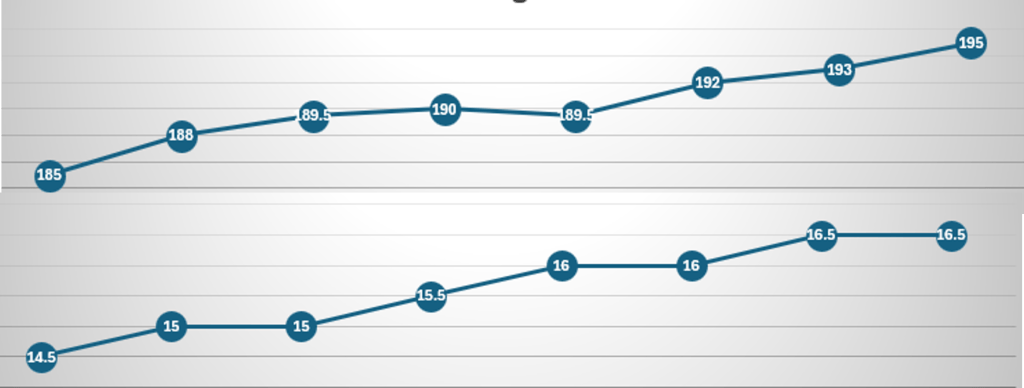
Here is a glimpse into a training program for an advanced trainee with concurrent goals: increasing chest and arm size and maintaining his aerobic capacity. Over the past 9 months he has put in lots of work and increased his circumference measures (a crude measure but data nonetheless) significantly. It has been great seeing his progress between these measures, pictures, and his training data. He has learned a lot about how much volume he needs to grow in this season of his life, his recovery, and volume cycling. I want to briefly touch on these things because I see many advanced trainees who would benefit from a perspective change.
Life Seasons
My client came into this with an extensive exercise history which helps us to understand comfort level, preference, and to a certain extent starting volumes. Albeit, not to the extent I feel most people assume. I have worked with thousands of people, and I can tell you that many things hold true and this statement is one of them: different seasons in life bring different barriers to training. This means that exercise selection and the volume you were accomplishing 2 years ago with great success may not be appropriate now. Why? Because you are the same person. Your life stressors aren’t the same, acute injuries may have crept in, your capacity may have changed, and how you respond to training stress may be different. Not to mention all the things I just don’t know.
Recovery
This is a nice segway into recovery. Everyone knows you should eat well, hydrate, sleep well, cease smoking and alcohol abuse, and not be stressed. I want to talk about how tracking your training can sometimes lead to insight and hopefully interventions toward recovery. At its core, muscle changes are the difference between muscle protein synthesis and muscle protein breakdown. Muscle protein is always being turned over, and when amino acids and kcal are readily available, and hormones are in their appropriate concentrations we find that protein synthesis is greater per unit of time, markers of protein breakdown are lessened per unit of time. Also, ecologically, people gain more LMM, lose more fat mass, and have better performance outcomes when compared to controls when they meet these recovery thresholds. When you track your training volume – sets/week/muscle group; sets/day/exercise; volume*load across time; etc. – I find that trainees start to see the impact that these factors can have on their performance and it acts as a motivational tool.
Volume Cycling
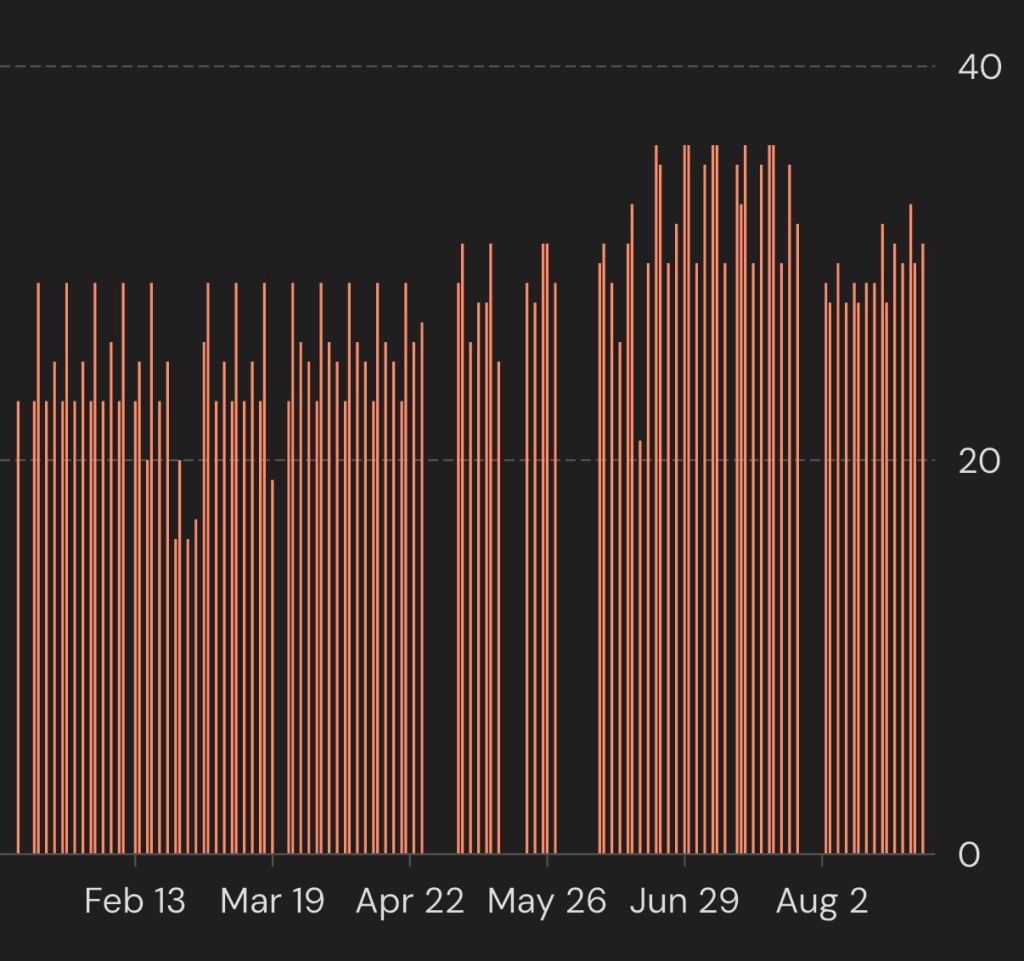
This is a periodization strategy, manipulation of training variables, with the goal of prioritizing volume toward a particular group of muscles and concomitantly decreasing volume on muscle groups in hopes of driving positive changes (hypertrophy) in the target muscle groups. I have found this to be my go-to for more advanced trainees who find themselves stagnant in both program improvements and body composition changes. The above example, my trainee had worked his weekly volume for all muscle groups up quite high which was just not sustainable. Injuries had crept in, less compound exercises were selected and now the see-saw of gains, stagnation, and loss became a reality. In these situations, I have seen success with implementation of moderate volumes with intentional deloads; but I also like volume cycling. For this client, we started out at ~18-30 sets/day, averaging 25, with emphasis on chest, bicep, and triceps exercises (about 22 sets/week/muscle group). Toward the end of the highest volume block, he was accomplishing ~36sets/day at 130 sets/week with our priority muscle groups averaging ~28-31% of the total weekly volume (34-41 sets/week/muscle group). I tend to give special attention to deloads, subjective rating of session and weekly RPE, and I tend to monitor some variables monthly to help drive some of these volume changing decisions.

