
We can quickly describe Resistance Training as applying resistance to a group of muscles in such a way that those muscles need to oppose, and hopefully overcome, that resistance. The resistance could be from dumbbells, barbells, bands, body weight, medicine balls, and the list goes on. Resistance training is important for general health for a multitude of reasons with the biggest one being that people who meet the minimum guidelines for resistance training experience a reduced risk of dying from all causes, and if that same person meets the minimum requirements for aerobic exercise (cardio) then that reduction becomes even more prominent.
The idea behind resistance training is that if we put an adequate amount of resistance on our muscles, they respond by getting larger, working together more efficiently (motor unit synchronization, muscle recruitment, increased neural activation, etc.), being able to produce force quicker, using energy better, storing energy better, among other adaptations. In addition, the surrounding structures such as the ligaments, tendons, and bones will become stronger. As these things take place, and we get stronger and more fit the “adequate” resistance that once was enough for making changes take place becomes inadequate and we must do something to make it adequate again and encourage more changes to take place. Luckily, an adequate amount of resistance training is much less complicated and time consuming than most people think.
The moral of the story is a person who is after general health should be meeting the minimum guidelines for both aerobic and resistance training exercise, and as both forms of exercise get easier that person should continue to challenge themselves to encourage more benefits.
The next question would be, what are the minimum guidelines for resistance training as it pertains to general health? I like to break this question down into six different areas: Frequency, Intensity, Type, Time, Volume, and Progression. I’ll be short and sweet…
Frequency (days/week)
The minimum should be resistance training 2 times per week. Although, most of my clients who have this goal train 3-4 times per week, but it’s all dependent on your training history, current fitness, current training, time constraints, etc.
Intensity (how hard)
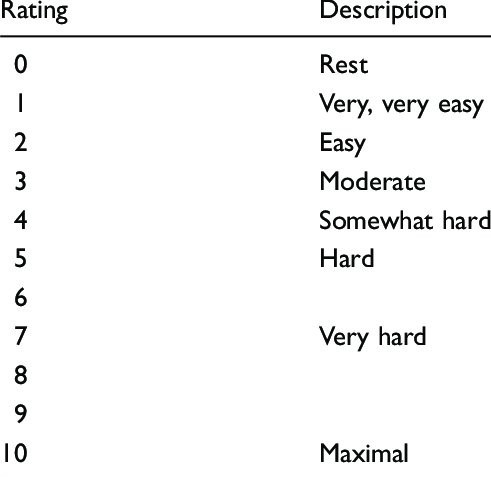
This refers to how hard your resistance training should be and while there are many different measures we could use (similar to “cardio” training) my favorite is the 10-point RPE scale (shown below). A great RPE range for resistance training would be 5-8 which roughly means that every time you do a resistance training exercise you would stop when you felt it was “Hard” or “Very Hard”; or you had about 2-5 repetitions left before you wouldn’t be able to complete another repetition. I personally don’t think that going much deeper into intensity than that, for general health purposes is needed. If someone becomes more interested in becoming stronger at a particular exercise than a deeper conversation could be had.
Type (of exercises)
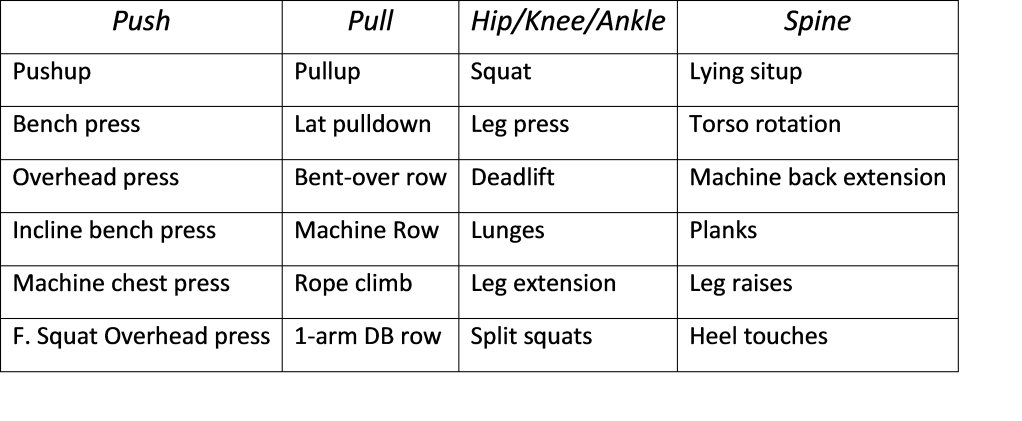
So, the classic recommendation here is “6-10 exercises working major muscle groups.” I personally frame it this way: We want to work all of our muscles, muscles work together to move our bones, our bones are connected at our joints, so we need exercises that involve bending all of joints in different ways to work all of our muscles. To me, this is simply pushing, pulling, bending hips/knees/ankles, and bending our spine. If you do those movements in some diverse ways, you will have successfully put resistance on all your muscles. When picking exercises that match these movement types, preference, discomfort, access, and other factors become important. Also, one exercise may fall into multiple categories. For example, a Squat and Deadlift both involve hip/knee/ankle bending but they also put a lot of resistance on the muscle involved in bending the spine. Likewise, the Bent-over Row exercise is a pulling exercise that will also put a fair amount of resistance on the spine muscles as well. Finally, the front-squat-overhead press is an exercise that combines the hip/knee/ankle bending Squat exercise with the overhead pressing (pushing) exercise. I normally start someone off with 2 different exercises per movement type on separate days and then build from that depending on tolerance and progression. As time goes on a person should sprinkle some variety in there and challenge themselves with new exercises. Examples of some exercises and their respective categories are below (P.S. they are all Googleable via their listed names).
Time (spent exercising)
It should take someone who is just after general health about ~30-90 minutes depending on exercises, warmup sets, volume that day, gym setup, etc.; however, certain techniques (drop sets, supersets, giant sets, cluster sets, 2x/day routines, etc.) can help make a workout quicker if needed.
Volume (amount of work you’re doing)
To address volume, we first need to understand reps and sets. A rep (repetition) is one complete motion of an exercise (from beginning to end range), and a set is a sequence of reps strung together in a controlled and uniform fashion. On paper they are usually listed as a number multiplied by another number with the first number being the sets and the seconds being the reps (3×10 would be 3 sets of 10 reps).
Volume can be calculated in different ways, sets x reps x weight lifted, sets x reps, or the number of “Hard” sets per week. I think for the purposes of general health a fine way to think of this is “hard” sets/week/muscle group or movement pattern or specific exercise (“Hard” is simply an RPE 5-8 discussed previously in the “Intensity” section). So, how many sets per week? The minimum guidelines for resistance training put out by a regulating body on exercise (ACSM) states that everyone should be doing at least 2 days/week of 1-4 sets of 5-15 reps per session, per muscle group, making sure to incorporate some exercises that work a lot of muscle groups. So, that would be 2-8 sets/muscle group/week with every set being 5-15 reps and an RPE 5-8. While I do think this is a good place to start, practical experience and training studies show that as people become more trained they will likely have to drift above 8 sets/week and closer to ~12-20 sets/week/muscle group, with the upper limits of that being for well-trained folks. So, taking this expanded range into consideration, somewhere between 2-20 sets/muscle group/week is a good guideline, with considerations such as training history, current training, progress, etc. dictating where one would start. The progression toward your goal of gaining muscle and strength) and subjective feedback (how hard it is, RPE rating) would then further drive any changes in sets/week.
Progression (keeping pace)
Progression refers to changing variables to encourage further adaptations. As you continue to resistance train and adaptations continue to occur the exercises that once were an RPE 7 will become an RPE 5. This change will decrease the overall stress that you’re getting and lead to slowed or stalled progress. To combat this one should change their training to increase RPE (increase weight, more volume, adding tempo, etc.). This is true for most physical endeavors. As you get better, you will need to do more to progress further. There are many different ways to get progress, but it starts with at least somewhat tracking what you’re doing and how hard it is and if you start to notice that stuff is easier or that your not making progress like you once were, something needs to change.
Here is an example of a way someone could progress: Find a starting volume, something that delivers results and is tolerated well. This is where the recommendations for volume come in handy. As your adaptations occur you’ll be able to lift the weight more reps. Once you hit the 15-rep “ceiling” discussed in the volume section go back down toward the lower end of the suggested rep scheme and increase the weight. Now, your doing 5-10 more pounds, but for 6-reps instead of 15-reps. Continue to work your new, higher weight until you get to the high-end of the rep scheme again, and do the same thing. If you find that a particular exercise is being troublesome (~2-4 weeks of stagnation), or that a particular muscle group is lacking compared to others, you should increase volume for that exercise, or exercises like it, or that lacking muscle group. You can do this by adding a set to the troublesome exercise, adding another similar exercise and starting with 1-2 sets of it at a lower intensity (easing it in), or add an exercise that puts stress on the muscle group you wish to see progress/growth in and start it the same way (1-2 sets at a lower intensity).
Rest and Expectations
Taking planned rests periodically is a great tactic in resistance training for multiple reasons (potential injury reduction, re-sensitization, decrease staleness, etc.). I find the average person does this throughout the year via family vacations, work trips, holidays, etc. There always seems to be a few weeks throughout the year where that person cannot train. If this isn’t the case for you, then planning a week of rest periodically, 10-20% of the year might not be a bad thing. Rest in this example could be no resistance training, in which case being closer to the 10% would be good; or decreasing what you’re doing by about 50-60% via the weight or volume, in which case 20% might be better.
Furthermore, you should expect that sometimes you’re going to be hitting a personal best on an exercise every week, and sometimes an exercise is just not going to budge for a few weeks. You will have to decrease weight sometimes to remain in your suggested RPE and rep range, while other times you’ll be able to do more reps to meet your RPE goal for that exercise. This is because you’re a HUMAN BEING! Understand that your goal is to build muscle and gain strength for general health and that’s a long process, be patient and enjoy it.
Example routine
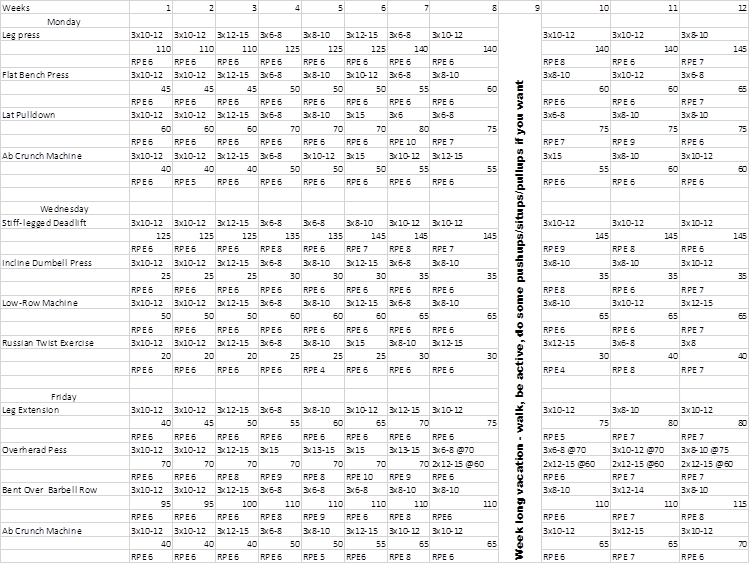
This is an example routine of a middle-aged man who came to me to improve his health who had very little resistance training experience but had been going to a fitness facility for a few weeks, had already received an orientation, but didn’t have a formal plan. The total volume is about 9-12 sets/muscle group/week, depending on the muscle group in question, and the rep range for all the exercises stayed between 5-15. RPE fluctuated but averaged RPE 6-7. On a few occasions RPE for an exercise drifted into the 8-9 range. When this happened, we simply kept everything the same for the next week and assessed again. In one instance an exercise acted “troublesome” and continued to be an RPE 8-9 and didn’t progress, the Overhead Press on Friday’s. You can see by week 6 the client has stalled out for multiple weeks fluctuating between 10-15 reps with higher RPEs than we want. Instead of adding another pushing exercise, we simply added another 2 sets at a lighter intensity hoping that the increased volume would lead to come changes in that muscle group and exercise specifically. This is just one example of how you might combat this.
 Grace Full Health